The transpacific market did not wait for July this year.
Vietnam sailings out of Ho Chi Minh City and Haiphong are fully booked through most of June. Indonesia now requires cargo commitments several weeks in advance. Cambodia is running feeder delays out of Phnom Penh. And the Shanghai Containerized Freight Index has surged for five consecutive weeks, reaching its highest point since September 2024, as carriers successfully pushed through June 1 General Rate Increases and Peak Season Surcharges simultaneously. (Source: Seatrade Maritime, June 2026.)
This is an unusually early and unusually aggressive peak season. And it arrived on top of a market already compressed by 100 days of Strait of Hormuz disruption, resumed Houthi attacks in the Red Sea, and an idle fleet sitting at just 0.6% of global capacity. There is no slack in the system. When a booking gets rolled — and right now, bookings are getting rolled — the downstream cascade hits fast.
The question is not whether your shipments will be affected. The question is whether you will know about it in time to do something.
What Rolling Risk Actually Costs
Rolling risk sounds like a carrier scheduling problem. It is not. It is a cost problem that starts the moment your team does not know a container has been bumped to the next vessel.
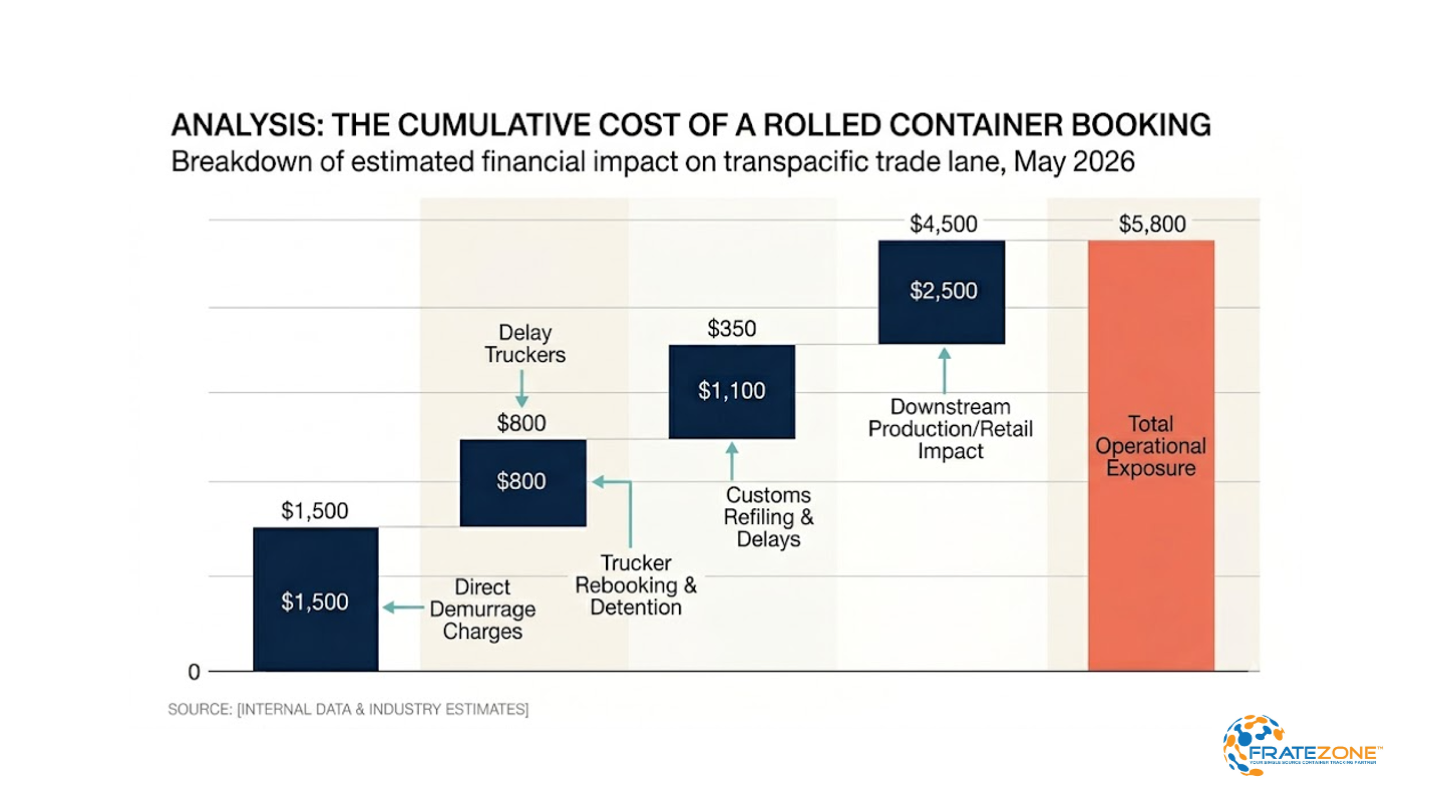
When a carrier rolls a booking, your original ETA moves by seven to fourteen days in most cases. That single event triggers a chain of costs that most logistics teams never fully quantify:
Customs and clearance timing. Documents filed against the original ETA now need to be refiled or held. Customs brokers rescheduled. Bonds and duties recalculated against a new arrival window.
Warehouse appointment loss. Most distribution centers and 3PL warehouses operate on tight receiving schedules. A rolled booking means your warehouse slot is gone. Rescheduling during peak season, when receiving calendars are compressed, often means an additional week of wait time.
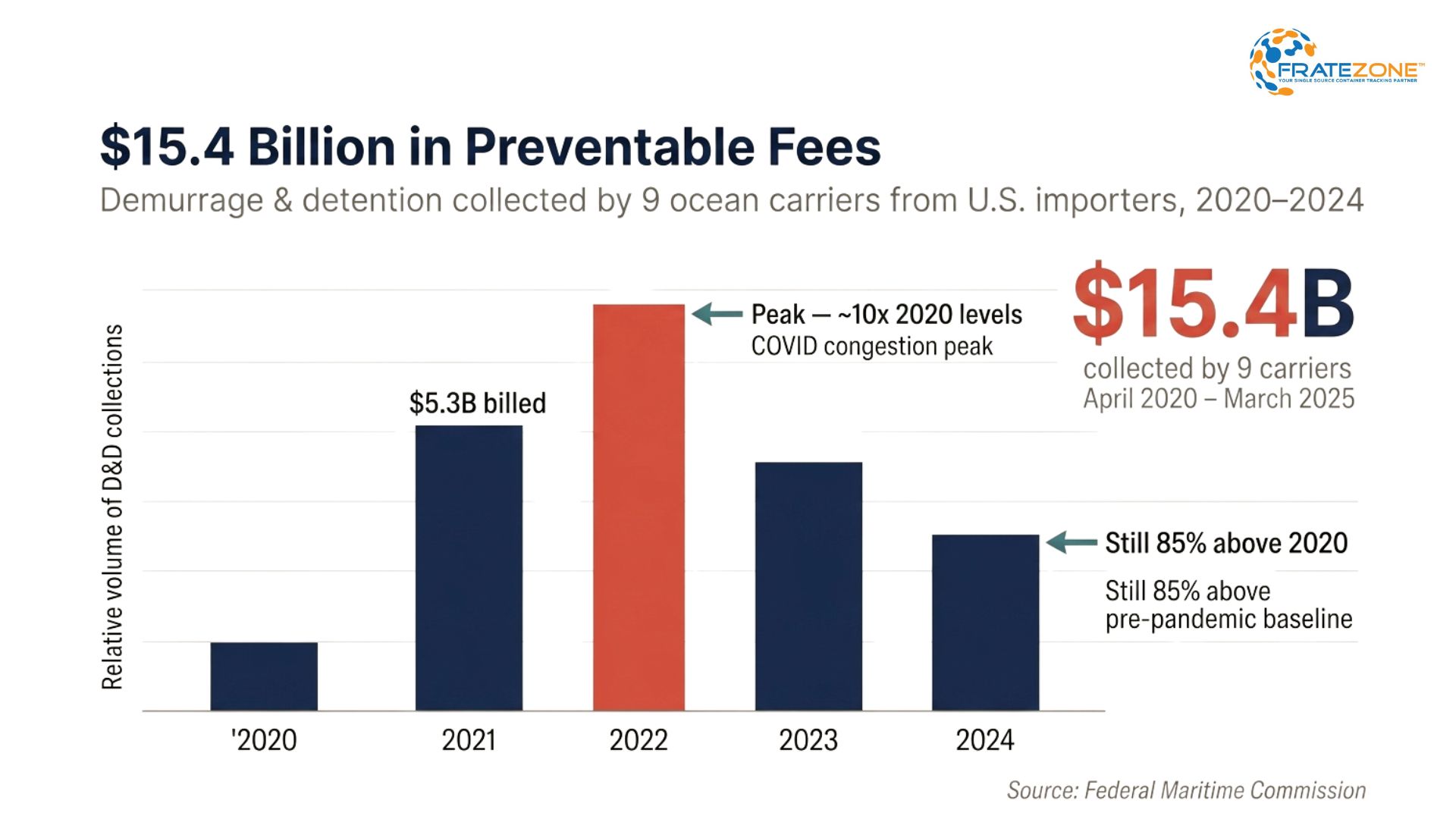
Demurrage exposure. When the container finally arrives on the later vessel, your team may not have received updated milestone data. The clock on free time starts running from discharge — not from when your team finds out the vessel arrived. At $100 to $300 per container per day, with tiered escalation after the first three days, five days of unplanned port dwell time costs between $500 and $1,500 per box. The Federal Maritime Commission reports carriers collected $15.4 billion in demurrage and detention charges between April 2020 and March 2025. Those fees are not going down: multiple major carriers updated their U.S. detention and demurrage tariffs upward effective January 1, 2026. (Source: Jade International, May 2026.)
Client relationship damage. If your customer is a retailer or distributor, they have a production schedule, a promotional window, or a retail floor reset tied to that inventory. A fourteen-day vessel roll they hear about from you three days before the new ETA is a very different conversation than one they hear about a week in advance. The first is a partnership. The second is a vendor problem.
Add it up across twenty open shipments during a compressed peak season and you are looking at a five-figure cost event from a visibility failure, not a logistics failure.
The Carrier Portal Problem Has a Compounding Effect in Tight Markets
During normal market conditions, logging into six or seven carrier portals each morning is inefficient. During a peak season with near-zero idle capacity, stacked GRIs and PSS, and booking allocation constraints across Southeast Asia, it is operationally dangerous.
Here is why: carrier portal data is not synchronized. A milestone update that posts on a carrier’s internal system at 11 PM does not necessarily appear in your portal login the next morning. In volatile market conditions, ETAs change multiple times before a vessel departs. A container that was confirmed departed on a Tuesday can be rolled to Thursday’s vessel by Wednesday afternoon, with the milestone update appearing in the carrier portal 18 to 36 hours later.
If your team is working across six portals, covering forty active shipments, each portal checked once per day, you have a systemic information lag baked into your process. In a normal market, the lag is an inconvenience. In a tight-capacity peak season with compressed free time and fully booked receiving schedules, the lag is the mechanism by which demurrage, warehouse missed appointments, and late client notifications happen.
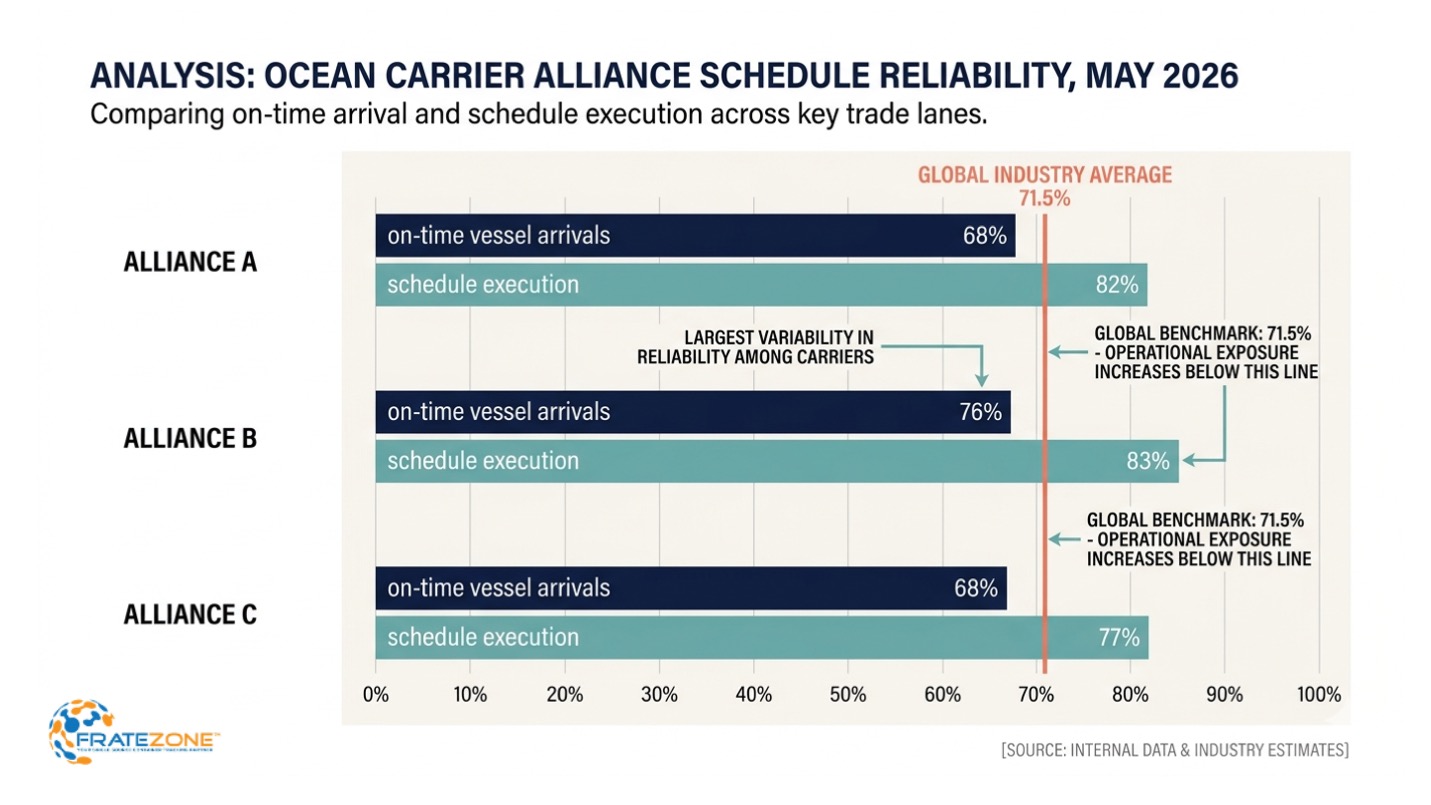
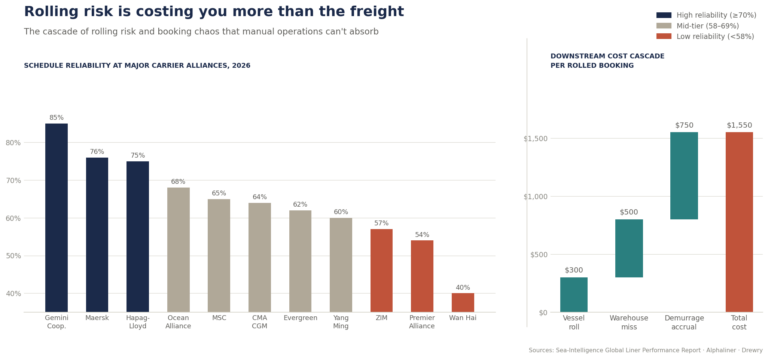
Sea-Intelligence’s Global Liner Performance data for early 2026 shows industry schedule reliability hovering between 59% and 62% through the first quarter, meaning roughly four in ten shipments are arriving off-schedule in some form. April improved to 67% for top carriers like Maersk and Hapag-Lloyd. But with the SCFI surging through May and June as early peak demand met near-zero spare capacity, schedule reliability will face pressure again. Even at 70% reliability, a logistics team with thirty active shipments should expect nine containers to deviate from their original ETAs in any given month. The operational question is: how fast do they find out?
What Your Team Is Actually Spending Time On
A logistics manager covering thirty active transpacific shipments in this environment is spending significant daily time on tasks that produce no operational value: logging into portals, cross-referencing spreadsheets, sending status request emails to forwarders, and manually updating an internal tracking document that is already out of date by the time it is sent.
Industry benchmarks put the manual tracking time for a mid-sized import operation at three to five hours per day across the team. That is not time spent solving problems. It is time spent finding out whether problems exist.
The compounding factor during peak season is that the team is already stretched. Booking confirmations are harder to get. Allocation constraints require more back-and-forth with carriers. Surcharge stacking means invoices need more review. The last thing an operations team needs during a capacity crunch is to have its best people spending the morning clicking through portals.
There is also a structural issue that goes beyond time: when tracking is manual, exception handling is reactive. You find out about the rolled booking when you check the portal. You find out about the ETA deviation when the carrier’s website updates. In a market where free time windows have tightened and receiving calendars are compressed, reactive exception handling is expensive exception handling.
A Framework for Assessing Your Visibility Gap
Before committing to any operational change, the right question is: what is your current visibility gap costing you in dollars per quarter?
Run this calculation:
- Take your average number of active ocean shipments per month.
- Multiply by the industry schedule reliability miss rate (30% to 40% of shipments will have some form of ETA deviation in a peak season market).
- Estimate the average cost per ETA deviation event: conservative is $300 to $500 per incident when you include partial demurrage, warehouse rescheduling, and broker rework. Complex incidents run $1,000 to $2,000.
- Add the labor cost of manual tracking: hours per day multiplied by the number of team members touching carrier portals, multiplied by their burdened hourly rate.
For a 3PL managing 100 active shipments per month, the math is straightforward: 35 to 40 deviations, at $400 average cost per event, equals $14,000 to $16,000 per month in deviation-related cost. Add $6,000 to $8,000 in manual tracking labor. That is a $20,000 to $24,000 per month problem that most operations teams are not tracking as a line item because the costs are distributed across demurrage invoices, overtime, and client credit notes.
The right question is not “can we afford a visibility platform?” It is “what are we already spending on the absence of one?”
The Operational Standard That Is Replacing the Spreadsheet
The operations teams that are navigating peak season 2026 most effectively share one characteristic: consolidated real-time visibility across their full open shipment book.
Not a tool that tracks one carrier. Not a portal that covers the carriers they happen to use most. A single operational desk where every active shipment, regardless of carrier, updates the moment the carrier pushes a milestone change.
This matters in a tight-capacity market for a specific reason: the carriers are not all updating on the same schedule. MSC’s platform, COSCO’s platform, Evergreen’s platform, and CMA CGM’s platform each post milestone data on different cadences. A team managing multi-carrier routing, which most mid-market importers and freight forwarders are doing right now because of Hormuz rerouting and Red Sea constraints, cannot get a coherent picture of their operation from individual carrier portals.
Consolidated visibility gives the operations team one version of the truth: every container, every carrier, every ETA update, in one place. When a booking is rolled, the milestone appears in the dashboard the moment the carrier logs it. The team does not find out three days later when a client calls. They find out the same day and begin the downstream coordination: warehouse rescheduling, customs broker notification, client communication.
The logistics teams using this approach are not just faster at exception handling. They are running a fundamentally different kind of operation: proactive rather than reactive, client-communicating rather than client-chasing, and analytically capable of measuring their own on-time performance across carriers, trade lanes, and time periods.
That last capability has become a competitive differentiator. A forwarder who can show a client a 90-day on-time performance report, broken down by carrier, has a client conversation that no one running spreadsheets can replicate.
What Changes When You Close the Gap
FrateZone Global consolidates real-time ocean container tracking across 210+ carriers into a single operational desk. Track by container number, MBL, or booking reference. Milestone updates post the moment the carrier pushes them. Built-in document management, role-based access for teams and clients, and shipment analytics give operations leaders the full picture they need to make decisions, not just check statuses.
For peak season specifically, the impact is measurable: ARC Global Logistics in Long Beach eliminated multi-portal searching and now runs daily milestone emails to clients from one dashboard. King’s Transfer Van Lines saved hours weekly and improved their customer experience by replacing their fragmented carrier login process with a single source of truth. Magna Technology in Tianjin reduced container tracking time by 70%.
The pattern is consistent: when teams stop spending the morning in portals and start working from a consolidated dashboard, they redirect hours per week from status-checking to exception resolution, client communication, and operational improvement.
At $10 per shipment, with bundles that never expire, the cost of consolidated visibility is not a budget question. It is an arithmetic question: is your current tracking gap costing you more than $10 per shipment to maintain? For any operation experiencing demurrage, missed warehouse appointments, or reactive client communication during this peak season, the answer is clearly yes.
The time lost waiting for containers costs far more than the freight itself. FrateZone enables real-time freight predictability across 210+ ocean carriers, turning your operational visibility into strategic program control. Learn more at www.fratezone.com/get-started